
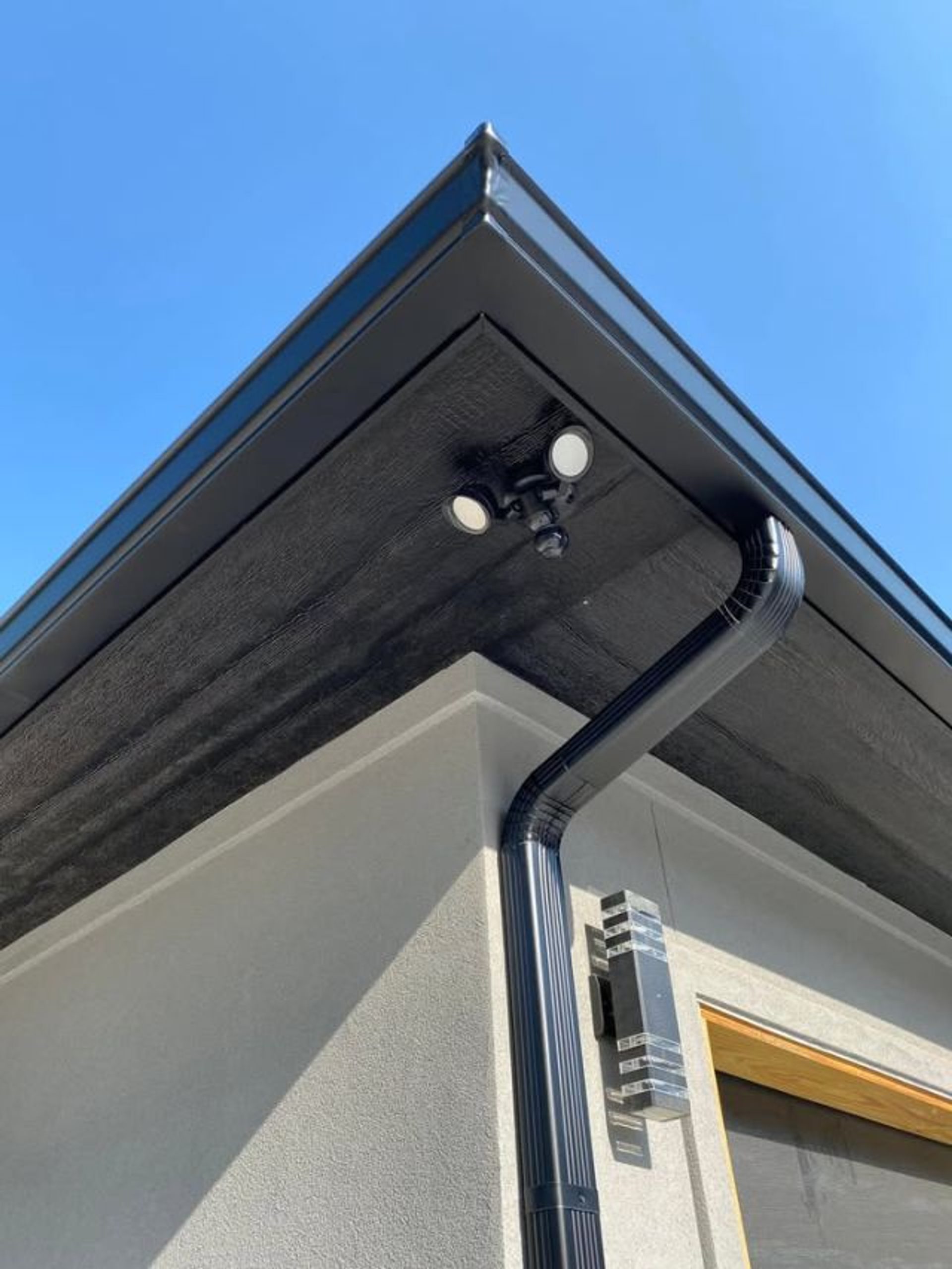
Gutter and Downspout Sizing Principles in Residential Applications
Abstract
Introduction
- The top width and cross-sectional area of the gutter (Fig.1)
- The largest interior dimension of the downspout (Fig.2)
- 3" Downspout - Any style whose largest dimension measures approximately 3" (e.g., 2"×3", 3" round, 3"×3" box)
- 4" Downspout - Any style whose largest dimension measures approximately 4" (e.g., 3"×4", 4" round, 4"×4" box)
- 5" Downspout - Any style whose largest dimension measures approximately 5" (e.g., 4"×5", 5" round, 5"×5" box)
Approximate Water Volume by Nominal Gutter Size
Nominal Gutter Size Gallons per Linear Foot (Approx.)
5" ~1.0 gallon
6" ~1.7 gallons
7" ~2.3 gallons
1. Identification of Distinct Climate Regions in the United States
- Arid / Semi-Arid (Southwest, Intermountain West)
- Moderate Rainfall (Midwest, portions of the Northeast)
- High Rainfall (Southeast, Pacific Northwest)
- Coastal Hurricane-Prone (Gulf Coast, Atlantic Coast)
- Snow-Dominant (Upper Midwest, Northern Plains, Mountain West)
2. Rainfall Totals and Intensity Considerations
- The Southeast experiences both high annual rainfall and high-intensity storm events.
- The Pacific Northwest sees high annual totals but often with lower peak intensities.
- Arid regions receive low annual totals yet may experience sudden high-volume monsoon events.
- Peak rainfall rate
- Roof surface area contributing to each gutter run
3. Severe Weather Considerations
Snow-Dominant Regions
- Ice accumulation reduces effective gutter capacity.
- Snow and ice slide can deform undersized systems.
- Larger nominal sizes provide both structural rigidity and volume buffer.
Hurricane / Coastal Regions
- Wind-driven rain increases instantaneous water entry rate.
- Tropical systems produce extreme short-term loads.
- Upsizing reduces overflow risk during rare but high-impact events.
4. The Role of Roof Size
- Total roof square footage
- Length of gutter runs
- Number of roof planes draining into a single run
- Valley concentration points
- Increasing gutter size
- Increasing downspout quantity
- Or implementing both adjustments
5. Relational Sizing Between Gutter and Downspout
- 5" gutter → 3" downspout
- 6" gutter → 4" downspout
- 7" gutter → 5" downspout
6. Outlet Size
3" ~220 gallon
4" ~390 gallons
5" ~612 gallons
7. Roof Material and Slope
- Water may overshoot narrower gutters.
- Additional nominal width improves capture efficiency.
8. Downspout Location Relative to Water Load
- Valley discharge areas should be supported by nearby downspouts.
- Concentrated valley discharge restricts lateral flow around inside corners; dead-end runs exceeding approximately 10 feet from an inside corner should be avoided without a downspout.
- Gutter runs exceeding 40 feet should avoid single-terminal discharge when feasible.
- 5" systems should target approximately 25 feet of gutter per downspout.
- 6" systems may reasonably extend to 35 feet per downspout under moderate rainfall conditions.
Real-World Hydraulic Comparison
- A 25' × 25' roof section (625 sq ft catchment area)
- Even distribution into a single 25-foot gutter run
- No slope inefficiencies or friction losses (idealized condition)
Scenario 1: High-Intensity Storm in East Texas
0.04 inches per minute
Step 1: Water Volume Generated
Step 2: Gutter Storage Capacity (25-foot run)
- 5" gutter (~1 gallon per foot)
- → ~25 gallons total capacity
- 6" gutter (~1.7 gallons per foot)
- → ~42 gallons total capacity
Performance Interpretation
- A 5" gutter approaches full capacity in little more than one minute of sustained peak rainfall.
- This leaves minimal tolerance for:
- Valley concentration
- Inside corners restricting lateral flow
- Splash velocity
- Minor debris accumulation
- A 6" gutter provides approximately 42 gallons of holding capacity - more than a 50% increase over the 5" system - creating meaningful hydraulic margin.
Scenario 2: Tropical Storm Conditions in Florida
0.10 inches per minute
Step 1: Water Volume Generated
Step 2: Gutter Storage Capacity (25-foot run)
- 5" gutter
- → ~25 gallons total capacity
- → Immediate overflow under sustained peak intensity
- 6" gutter
- → ~42 gallons total capacity
- → Minimal performance margin
- 7" gutter (~2.3 gallons per foot)
- → ~57 gallons total capacity
- → Provides meaningful buffer for:
- Valley concentration
- Corners
- Partial debris obstruction
- Short-duration peak surges
Observational Conclusion
9. The Role of Leaf Protection in Sizing Considerations
10. Cost Considerations and Market Realities
- Tract homes and "affordable housing" developments under approximately 1,500 sq ft commonly utilize 5" systems regardless of regional rainfall intensity.
- In coastal or extreme rainfall regions, residential installations may approach light commercial sizing (e.g., 7" gutter with 5" downspouts) to establish a meaningful performance margin.
Conclusion
- Regional rainfall intensity
- Severe weather exposure
- Roof catchment area
- Product availability
- Market positioning
- Relational Sizing Principle: Gutter size minus approximately 2 inches corresponds to appropriate downspout size.
- 5" Systems: Approximately 25 feet of gutter per downspout is a reasonable performance target.
- 6" Systems: May expand up to 35 feet per downspout under moderate rainfall conditions without sacrificing function.
- Moderate to Heavy rainfall regions: 4" downspouts often represent a practical baseline.
- Coastal Regions: 7" gutter systems provide increased hydraulic margin.
- Ensure gutter machine is properly adjusted with the back of the gutter taller than the front lip. (Fig.3)
- Install gutters behind the drip edge when feasible. (note: coastal regions often have specific building practices that may interfere with what are best installation practices in other regions.)(Fig.4)
- Always avoid configurations that allow overflow to access wall cavities or interior assemblies.
Version
V.1.0 03.05.26
(v.1.1 04.12.26 - addition of dcGutterPRO as Reviewer)