
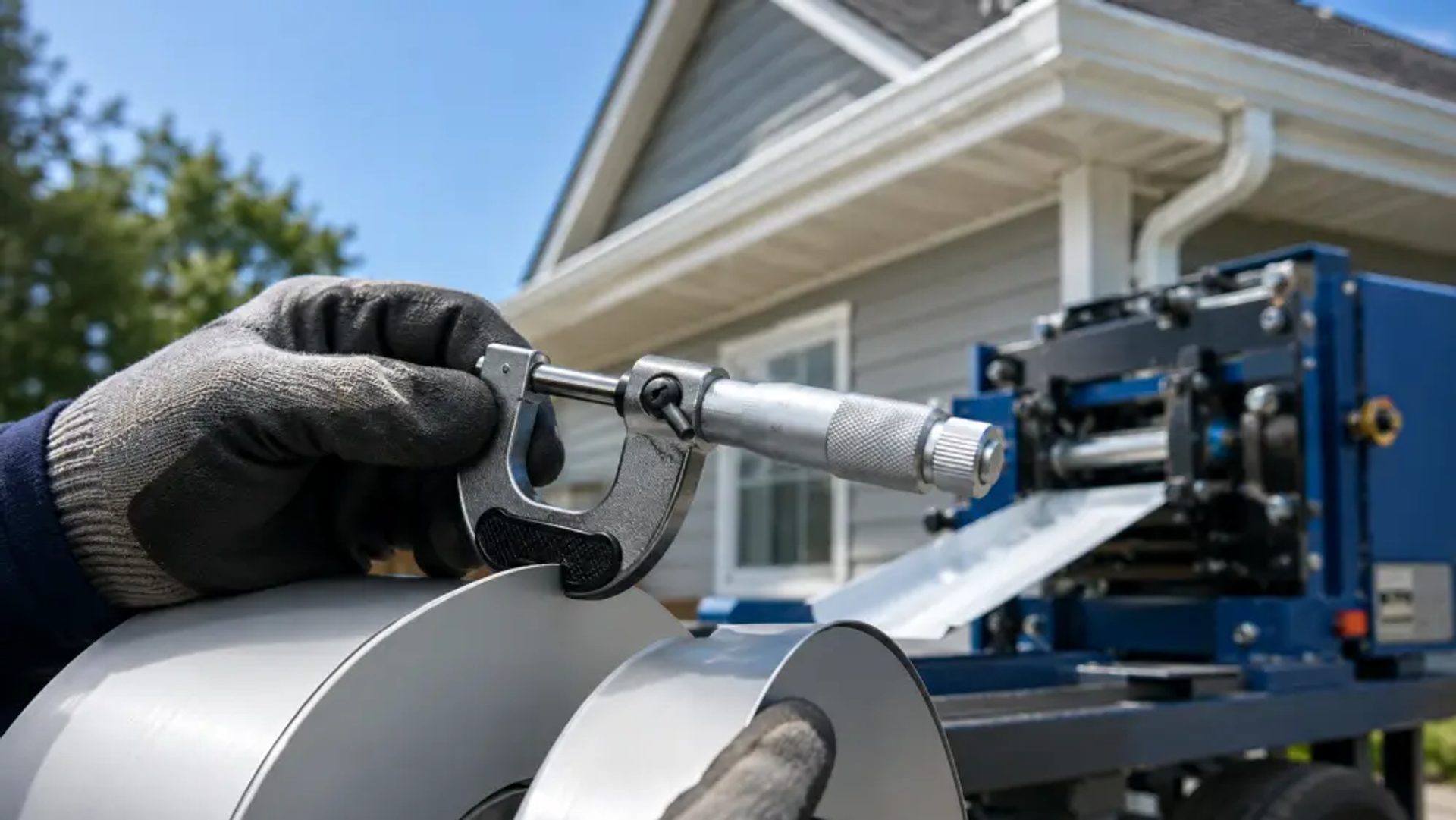
Coil Thickness Standards in Residential Installation
Abstract
Introduction
- Anecdotal evidence used by local installers
- Cold climate performance
- Heat-related deformation ("heat buckle")
- Performance in uncommon gutter profiles
1. Anecdotal Evidence Used by Local Installers
- Historical availability from local suppliers
- Perceived stiffness during forming
- Call-back frequency
- Market price sensitivity
- Hanger spacing
- Snow load calculations
- Thermal expansion coefficients
- Gutter run length
2. Cold Climate Considerations
- Snow load accumulation
- Ice formation and freeze-thaw cycling
- .032 exhibits reduced flex between hangers
- .027 may require closer hanger spacing to achieve similar rigidity
- Long 6" runs in .027 are more prone to visible deformation if hanger spacing exceeds 24"
3. Heat Buckle and Thermal Expansion
- Run length
- Fastening method
- End cap and miter constraints
- Expansion joint usage
- .027 may exhibit visible waviness ("oil-canning") more readily in long sun-exposed runs
- .032, due to increased stiffness, may resist minor surface distortion but may transfer expansion stress more aggressively to fasteners if improperly installed
4. Uncommon Gutter Profiles
- .032 often provides noticeably greater rigidity
- .027 may flex more visibly even in milder temperature swings
- Decorative or historic, or 'premium' applications may benefit from thicker coil to reduce visual distortion
Additional Considerations
Recommended Installation Practices to Minimize Material-Related Failures
- Use .032 Coil in areas that experience wide temperature swings
- Space hangers at a maximum of 24" in non-snow regions and 16" in snowy regions (tighter spacing for snowy regions in conjunction with metal panel roofs that may cause large sliding ice sheets)
- In volatile temperature regions, implement a minimum install temperature; Ideally around 50°F. This allows your gutter to be mounted relatively close to it's 'mid-point' of movement.
- The use of wide-lipped hangers such as the GPI Boss, as opposed to narrower brackets like the Alcoa style Hangtite may add front lip stability, potentially reducing waviness between hangers. The increased width - more than 2x in the two mentioned examples, means more support for the front lip of the gutter.
- In volatile temperature regions limit Gutter runs to less than 60 feet without expansion joints.
- Avoid using .027 on profiles with large unsupported flat surfaces, like Euro Box, Straight-Face and Fascia Styles.
- Avoid Installing Gutter under excess pressure, like Drip Edge Flashing that is tight and requires the installer to have to force the gutter behind it.
- Avoid solo installing long runs. The stress and stretching introduced to the run while carrying it up the ladder (picture the ends sagging down) doesn't go away when the screws go in. Evenly supporting the run all the way from the machine, to the run-out stands to the eave limits the amount of stress the run is attached with.
- In any application there the back of the gutter is not fully up against a fascia (e.g. Angled fascia or Permanent Drip Mold) Be sure to include a stress relieving system like Gutter Bumper, T-Wedge or Full-Length E-Wedge. This isn't technically 'added' support as much as it is restoring necessary support.
Conclusion
Version
V.1.0 03.05.26
(v.1.1 04.12.26 - addition of dcGutterPRO as Reviewer)